Munich Airport (MUC) Flight Compensation: Complete Guide to Your Passenger Rights
Avioza Team10 min read
No Win, No Fee98% Success RateEU-Wide Coverage
Key Takeaways
EU261 applies to ALL flights departing Munich on any airline -- Germany is a full EU member state with comprehensive passenger protection
Munich handles 48 million passengers annually as Lufthansa's secondary hub, with Terminal 2 and its satellite dedicated to Star Alliance operations
Alpine proximity brings heavy winter snow and de-icing delays, while the Erdinger Moos marshland generates persistent autumn fog that cuts runway capacity
Compensation is EUR 250 to EUR 600 per passenger -- a family of four on a long-haul route through Munich could claim EUR 2,400
German law gives you 3 years to file (BGB Paragraph 195) with the clock starting at year-end, but early filing dramatically improves evidence quality
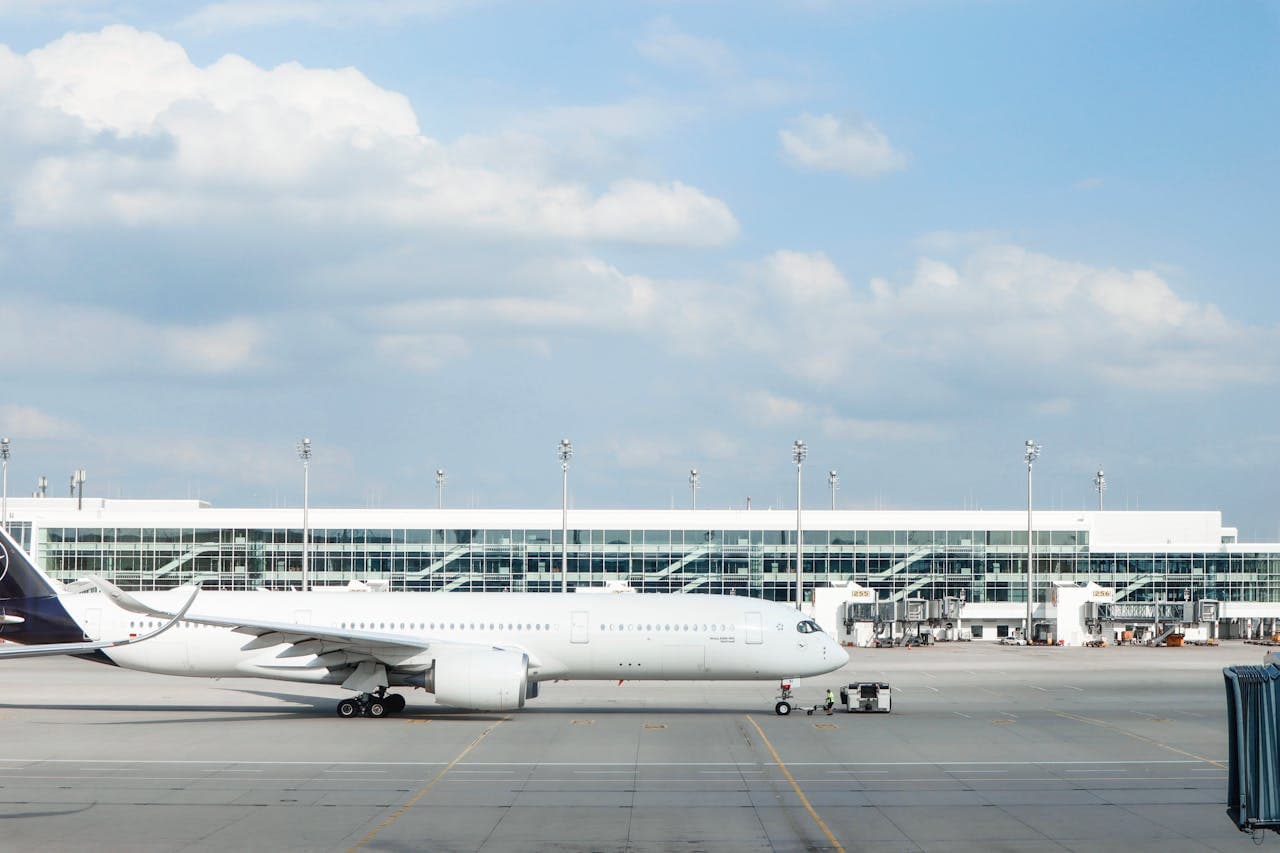
Munich Airport (MUC), officially Franz Josef Strauss Airport, is Germany's second-largest aviation hub and one of Europe's most important connecting airports. Named after Bavaria's long-serving Minister-President, this sprawling facility 28 kilometres northeast of Munich city centre handles approximately 48 million passengers annually and serves as Lufthansa's secondary intercontinental hub. Together with Frankfurt, Munich forms the backbone of the Lufthansa Group's global network, connecting European feeder routes to long-haul destinations across the Americas, Asia, Africa, and the Middle East.
But Munich's operational profile creates a specific and recurring pattern of disruptions that differs markedly from other major European airports. The airport sits on the Erdinger Moos -- a former marshland that generates persistent low-level fog in autumn and early winter -- at an elevation of 448 metres, where proximity to the Alpine ridge brings heavy snowfall, sub-zero temperatures, and the need for extensive aircraft de-icing from November through March. When winter weather coincides with peak hub connecting traffic, the result is a cascade of delays and missed connections that affects passengers across the entire Lufthansa Star Alliance network.
If your flight at Munich Airport was delayed by more than 3 hours, cancelled without adequate notice, or you were denied boarding, you are entitled to up to EUR 600 in compensation under EU Regulation 261/2004. As a German airport within the EU, Munich provides full and comprehensive passenger protection.
EU261 Coverage at Munich: Every Departure Is Protected
Germany's EU membership means that every flight departing Munich is covered by EU261, regardless of which airline operates it:
Your Flight
EU261 Applies?
Why
Munich to anywhere on any airline
Yes
All departures from EU airports are covered
Non-EU airport to Munich on EU airline (e.g., Lufthansa)
Yes
EU-carrier arrivals from outside the EU are covered
Non-EU airport to Munich on non-EU airline (e.g., Turkish Airlines)
No
Non-EU carrier from a non-EU departure point
Key insight: Munich hosts flights by carriers from around the world -- Emirates, Turkish Airlines, Qatar Airways, United Airlines, and many others. All of these are fully covered by EU261 when departing from MUC. Airlines occasionally try to argue otherwise, particularly non-EU carriers unfamiliar with European regulations. Do not accept this -- your departure point determines your rights.
Disrupted at Munich Airport?
Winter weather claim specialists for MUC
No win, no fee -- you pay nothing unless we succeed
Thousands of Munich hub claims resolved successfully
EU261 compensation depends exclusively on flight distance. Your ticket price has no bearing on the amount:
Route Type
Distance
Example Routes from MUC
Compensation
Short-haul
Under 1,500 km
Munich to Milan, Vienna, Prague, Zagreb
EUR 250
Medium-haul
1,500 -- 3,500 km
Munich to London, Istanbul, Tel Aviv, Casablanca
EUR 400
Long-haul
Over 3,500 km
Munich to Dubai, Los Angeles, Singapore, Cape Town
EUR 600
These amounts apply per passenger. A couple delayed on a Munich to Los Angeles Lufthansa flight could claim EUR 1,200 combined. Importantly, if your disrupted journey involved a connection through Munich and was booked on a single ticket, the compensation is calculated on total journey distance -- often pushing medium-haul segments into the EUR 600 bracket.
What Causes Disruptions at Munich Airport
Munich has a distinctive operational fingerprint when it comes to delays and cancellations. Understanding these specific causes helps you evaluate whether an airline's defence is legitimate or merely convenient.
Erdinger Moos Fog
The airport sits on the Erdinger Moos, a low-lying former marshland between the rivers Isar and Sempt. This flat, moisture-rich terrain generates radiation fog with remarkable consistency from late September through December. When fog settles on the Moos, it can reduce visibility below CAT IIIb minimums, forcing the airport to implement low-visibility procedures that dramatically reduce runway throughput. Aircraft spacing increases, approach speeds decrease, and the hourly movement rate can drop from over 90 to fewer than 40 operations.
Claim impact: Erdinger Moos fog is one of the most predictable and well-documented weather phenomena in European aviation. Munich's own aviation weather station records fog events with precise frequency data going back decades. Airlines building hub schedules through MUC in autumn know that fog is statistically probable. German courts have ruled multiple times that seasonal fog at Munich does not automatically constitute an extraordinary circumstance, especially when the airline's schedule did not include adequate buffer time for foreseeable conditions.
Alpine Winter Weather and De-icing
Munich's proximity to the Alps -- the peaks are visible from the airport on clear days -- brings substantial winter weather from November through March. Heavy snowfall can accumulate quickly, requiring runway clearance operations that temporarily close individual runways. More commonly, sub-zero temperatures necessitate aircraft de-icing before every departure, a process that adds 15 to 45 minutes per aircraft depending on conditions and the available de-icing capacity.
Munich Airport operates centralised de-icing pads rather than gate de-icing at most stands, which means aircraft must taxi to the de-icing area, wait in queue, undergo treatment, and then taxi to the runway -- a sequence that can add over an hour to departure times during heavy snowfall periods.
Claim impact: Winter snow at Munich is not extraordinary -- it is a defining characteristic of the airport's operational environment. Airlines that choose to hub through Munich must resource their operations accordingly, including contracting sufficient de-icing capacity. German courts distinguish between unprecedented weather events (a freak ice storm in July) and foreseeable seasonal conditions (snow in January at an Alpine airport). Claims based on routine de-icing delays at Munich have a strong track record of success.
Hub Connecting Traffic and the Domino Effect
As Lufthansa's secondary intercontinental hub, Munich handles a massive volume of transfer passengers daily. The hub operates on carefully timed connecting waves: feeder flights from across Europe arrive in coordinated banks, passengers transfer through Terminal 2, and long-haul flights depart in subsequent banks. When winter weather delays the incoming feeder wave by even 30 minutes, the entire outbound wave shifts, creating a ripple of delays that can persist for the rest of the day.
The minimum connection time (MCT) at Munich varies by terminal: 30 minutes within Terminal 2, 40 minutes between Terminal 2 and the satellite, and 45 minutes between terminals. But these are theoretical minimums that assume no queues, no gate changes, and no delays at security or passport control. In practice, tight connections are frequently missed.
Claim impact: Missed connections through Munich are extremely common and represent some of the highest-value EU261 claims. When your journey was booked on one ticket and you arrived at your final destination more than 3 hours late, compensation is calculated on total journey distance. A passenger connecting in Munich from Berlin to Tokyo on a single Lufthansa ticket can claim EUR 600 -- even though the Berlin-Munich leg alone would only qualify for EUR 250.
Runway Configuration Constraints
Munich operates two parallel runways (08L/26R and 08R/26L) oriented roughly east-west. While this provides good capacity in normal conditions, the parallel configuration means both runways are affected simultaneously by crosswinds from the Alpine Foehn -- a warm, dry wind that can produce sudden and severe turbulence on approach. When strong Foehn conditions develop, approach spacing must increase and the airport's effective capacity drops significantly.
Additionally, runway maintenance requires periodic closure of one runway, temporarily cutting the airport's theoretical capacity in half and creating delays across the hub schedule.
Claim impact: Foehn winds are a well-known Alpine meteorological phenomenon that occurs regularly, particularly in spring and autumn. While extreme Foehn events may qualify as extraordinary, mild to moderate Foehn conditions are foreseeable and do not exempt airlines from compensation obligations. Runway maintenance closures are entirely planned and never constitute an extraordinary circumstance.
Disrupted at Munich Airport?
Winter weather claim specialists for MUC
No win, no fee -- you pay nothing unless we succeed
Thousands of Munich hub claims resolved successfully
Step-by-Step: How to Claim Compensation for Your Munich Flight
Filing a compensation claim with Avioza is straightforward and carries zero financial risk.
Collect your documentation -- You need your booking confirmation or e-ticket number, boarding pass (paper or mobile), and any communication from the airline about the disruption. If you have photos of departure boards, screenshots of delay notifications from airline apps, or receipts for meals and hotels, gather these too.
Check your eligibility -- Enter your flight details in our free online tool. We cross-reference airline registration, route distance, actual arrival times, and disruption cause to confirm EU261 coverage.
Submit your claim -- Complete the form with your personal and flight details. Our legal specialists take over from this point.
We handle the airline -- We contact the airline with a legally substantiated claim, backed by weather data, operational records, and regulatory precedent. If the airline rejects the claim or ignores it, we escalate to the LBA, the SOeP, or court proceedings.
You receive payment -- Once resolved, we transfer your compensation minus our transparent success fee. No success means no cost to you whatsoever.
Your Care Rights During Disruptions at Munich
While waiting at Munich, airlines have immediate legal obligations regardless of the disruption's cause:
Free meals and refreshments after 2 hours (short-haul) or 3 hours (medium/long-haul) of delay
Hotel accommodation for overnight delays, including transport between the airport and hotel
Two free communications -- calls, emails, or messages
Refund or re-routing if your flight is cancelled -- you choose between an alternative flight or a full refund
Munich Airport has excellent terminal facilities including the famous Airbraeu brewery between terminals, but airline care obligations are separate from airport amenities. The airline must provide or reimburse care regardless of what the airport offers commercially.
Escalation Routes: LBA and SOeP
If an airline rejects your Munich claim, Germany provides two formal escalation mechanisms:
The Luftfahrt-Bundesamt (LBA) investigates passenger complaints free of charge and can compel airline compliance. The SOeP offers faster alternative dispute resolution with binding recommendations. At Avioza, we select the optimal escalation path for each case, leveraging our experience with thousands of Munich-specific claims to maximise the probability of a swift resolution.
Time Limits and Evidence Preservation
The 3-year German limitation period (BGB Paragraph 195) starts at year-end, giving you a generous filing window. But Munich claims face a specific evidence challenge: de-icing records, ground handler shift logs, and hub scheduling data are often purged after one winter season. The airlines know this. Filing promptly after your disrupted flight ensures we can access the operational detail needed to counter any extraordinary circumstance defence.
Disrupted at Munich Airport?
Winter weather claim specialists for MUC
No win, no fee -- you pay nothing unless we succeed
Thousands of Munich hub claims resolved successfully
Munich's unique combination of winter weather, hub complexity, and high-value connecting traffic creates claims that require deep expertise. Lufthansa's legal team in Munich routinely deploys winter weather defences that conflate routine seasonal conditions with genuinely extraordinary events. Low-cost carriers at Terminal 1 often simply ignore claims, banking on passengers giving up.
Winter weather claim specialists -- we analyse METAR data, de-icing logs, and runway condition reports for every MUC claim
No win, no fee -- zero financial risk to you at any stage
Hub connection expertise -- we understand Lufthansa's wave scheduling system and know when missed connections are the airline's fault
LBA and SOeP escalation -- we file with German authorities when airlines refuse to engage
Fast resolution -- most Munich claims are resolved within 8 to 10 weeks
Frequently Asked Questions
Does EU261 apply to all flights at Munich Airport?
Yes, comprehensively. EU261 applies to every flight departing Munich Airport regardless of which country the airline is registered in. Whether you fly Lufthansa, Emirates, Ryanair, Turkish Airlines, or any other carrier from MUC, your departure is covered. For flights arriving in Munich from outside the EU, the regulation applies only when the operating airline is EU-registered. Since Munich is Lufthansa's second-largest hub and a major Star Alliance connecting point, the vast majority of all MUC flights are fully covered. This includes the extensive Lufthansa Regional and Eurowings operations that feed the hub.
How much compensation can I claim for a delayed Munich flight?
Under EU261, compensation is calculated by flight distance alone. You can claim EUR 250 for flights under 1,500 km (for example Munich to Milan, Vienna, or Prague), EUR 400 for flights between 1,500 and 3,500 km (such as Munich to London, Istanbul, or Tel Aviv), and EUR 600 for flights over 3,500 km (like Munich to Dubai, Los Angeles, or Singapore). These are per-passenger amounts and apply regardless of what you paid for the ticket. Your flight must arrive at its final destination more than 3 hours late. For families and groups, the amounts multiply: four passengers on a delayed long-haul flight from Munich could recover EUR 2,400 combined.
My Munich flight was delayed by snow and de-icing -- can I still claim?
Munich sits at 448 metres elevation at the foot of the Bavarian Alps and receives significant snowfall from November through March. While a genuinely unprecedented blizzard might qualify as an extraordinary circumstance, routine winter snowfall and standard de-icing operations are entirely foreseeable at MUC. Airlines operating from Munich must factor de-icing time into their winter schedules. German courts have repeatedly ruled that de-icing delays at Munich do not automatically exempt airlines from compensation. If the delay was disproportionate to the actual weather conditions, or the airline failed to organise de-icing crews efficiently, your claim is likely to succeed. We analyse official METAR and TAF weather reports for every Munich claim to distinguish genuine extraordinary weather from routine winter operations.
What happens if I miss my Lufthansa connection at Munich Airport?
Munich is Lufthansa's second-largest hub, processing tens of thousands of transfer passengers daily through Terminal 2 and its satellite building. Missed connections are extremely common, particularly during the winter months when de-icing delays and weather disruptions cascade through the hub schedule. If your entire journey was booked on a single ticket (whether directly with Lufthansa or through a Star Alliance partner) and you arrived at your final destination more than 3 hours late because you missed your Munich connection, you can claim compensation based on the total journey distance. Intercontinental connections through Munich frequently qualify for the maximum EUR 600. The minimum connection time between Terminal 2 gates is 30 minutes, but connections involving the satellite terminal or Terminal 1 require significantly longer.
How does Munich Airport's terminal structure affect my rights during disruptions?
Munich has two main terminals plus a satellite building. Terminal 2 is the dedicated Lufthansa and Star Alliance hub, connected to the satellite terminal by an underground automated people mover. Terminal 1 handles most other airlines including Eurowings (in certain halls), Ryanair, easyJet, and non-alliance carriers. During disruptions, where you are physically located determines how quickly you receive care. Terminal 2 passengers typically receive Lufthansa vouchers more promptly, while Terminal 1 passengers dealing with low-cost carriers may need to be more assertive. Regardless of terminal, your legal rights are identical -- the airline must provide meals, refreshments, communications, and hotel accommodation as required by EU261.
How long do I have to file a claim for a disrupted Munich flight?
Under German law (BGB Paragraph 195 and Paragraph 199), you have 3 years from the date of the disrupted flight. The limitation period begins at the end of the calendar year in which the flight occurred, so a disrupted flight on 5 February 2024 gives you until 31 December 2027. This is one of the more generous time limits in the EU. However, Munich winter weather claims are particularly time-sensitive because airlines and ground handlers rotate de-icing records seasonally and may purge detailed operational logs after 12 months. Weather data from the Erdinger Moos station is archived, but airline-specific decisions about de-icing sequencing and crew allocation become much harder to verify after the first year.
Ready to Claim Your Compensation?
It takes less than 3 minutes to check. No win, no fee.
Was your flight at Lentoasema (JYV) delayed or cancelled? Under EU Regulation 261/2004, you may claim up to €600. 1. Gather documents 2. Free eligibility check
Was your flight at Lentoasema (MHQ) delayed or cancelled? Under EU Regulation 261/2004, you may claim up to €600. 1. Gather documents 2. Free eligibility check
Karpathos Island National Airport (AOK) is one of Greece's most remote and operationally challenging aviation hubs, nestled in the Dodecanese archipelago between Rhodes and Kastellorizo. Serving the windswept island of Karpathos, this small airport handles seasonal international charters, domestic connections, and increasingly unpredictable flight disruptions due to severe weather and limited operational capacity.