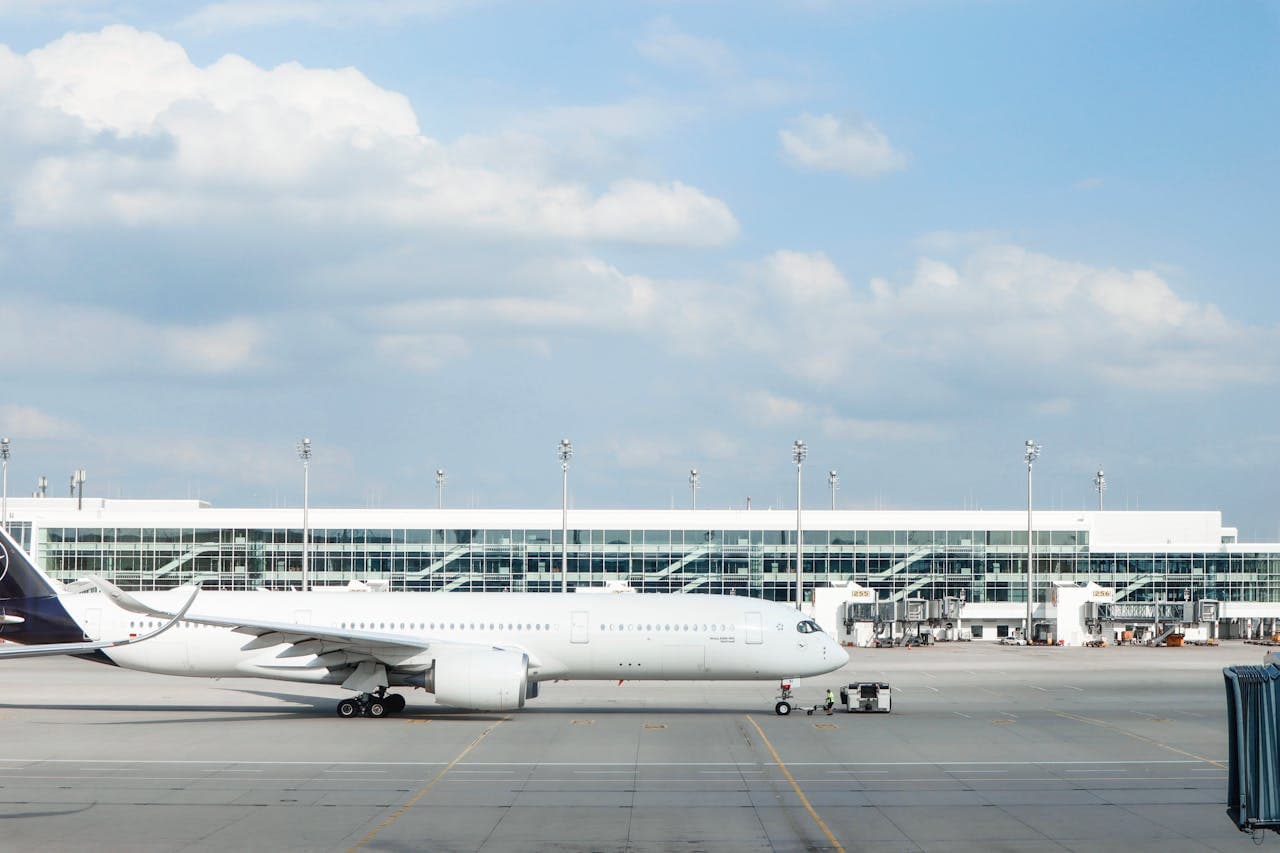
Exe Estuary Fog: The Localised Threat
Exeter Airport's proximity to the Exe Estuary — where the River Exe meets the English Channel at Exmouth — creates one of Devon's most specific and distinctive weather risks. The estuary acts as a moisture source that generates highly localised fog conditions. When cool air sits over the warmer river water, or warm air flows over cooler estuary surfaces, radiation fog and advection fog can form rapidly at the airport.
This estuary fog is notoriously localised. Exeter city centre, just 8 kilometres away, may enjoy clear skies while the airport is socked in below landing minima. Pilots on approach can find themselves descending from clear air into a thick fog bank with almost no warning. The effect is most pronounced on still autumn and winter mornings when temperature inversions trap the moisture layer close to the ground.
Spring and early autumn are the worst seasons for Exe Estuary fog — the transition periods when temperature differentials between land, water, and air are at their greatest.
Claim impact: Exe Estuary fog is one of the most thoroughly documented local weather phenomena in Devon. The Met Office maintains specific observation records for Exeter Airport that detail fog frequency by month, time of day, and season. Airlines operating from a site adjacent to a major estuary have complete access to this data. Routine estuary fog events that fall within documented historical frequency ranges are entirely foreseeable. Airlines must schedule with appropriate fog margins, particularly during the known fog-prone months.
Dartmoor Orographic Effects: The Western Influence
Dartmoor National Park lies to the west and northwest of Exeter, rising to 621 metres at High Willhays — the highest point in southern England. This substantial upland mass has direct meteorological consequences for the airport:
- Orographic cloud and rain — Moisture-laden westerly winds forced upward by Dartmoor's slopes produce cloud and precipitation that extend downwind to the Exeter area. The airport can experience persistent low cloud and drizzle that is directly caused by Dartmoor's presence.
- Cold air drainage — On clear nights, cold dense air pools over Dartmoor's high ground and flows downhill through valleys toward the coast. This cold air drainage can create unexpected frost and ice at Exeter Airport when surrounding lowland areas remain above freezing.
- Lee wave turbulence — Under certain wind conditions, the airflow over Dartmoor generates lee waves and rotors downwind. While not typically severe enough to close the airport, this turbulence can affect approach stability and cause go-arounds.
Claim impact: Dartmoor has been in the same location for geological timescales. Its influence on Exeter's weather is a permanent, unalterable geographical fact. Airlines operating from an airport downwind of a 621-metre moorland mass must factor Dartmoor effects into their scheduling and crew training. This is not extraordinary — it is the baseline operational environment.
English Channel Moisture
The English Channel to the south provides the third arm of Exeter's weather triple threat. South-westerly winds — the prevailing wind direction in Devon — carry Channel moisture directly to the airport. Summer sea breezes can produce sudden wind direction changes during the afternoon, requiring runway changes and potentially disrupting approach sequences. Winter Channel depressions track along the south coast bringing sustained rainfall, strong winds, and occasionally severe storms.
Claim impact: English Channel weather patterns are among the most studied and forecast in the world. Centuries of maritime observation, modern satellite coverage, and the Channel's strategic importance mean that weather data is extraordinarily comprehensive. Airlines have no excuse for being surprised by Channel weather.
Post-Flybe Operational Fragility
The collapse of Flybe — twice — removed the operational backbone that sustained Exeter Airport for decades. During the Flybe era, the airport had:
- Resident aircraft — Multiple Flybe aircraft based overnight at Exeter, providing rapid service recovery
- On-site engineering — Flybe maintained an engineering facility at the airport for aircraft maintenance
- Rostered crew — Pilots and cabin crew based in the Exeter area, available for scheduling flexibility
- Ground handling expertise — Experienced ground staff handling dozens of daily Flybe turnarounds
All of this infrastructure disappeared with Flybe. Today's replacement carriers — primarily Ryanair and TUI — operate from their own distant bases. When a Ryanair aircraft at Exeter develops a technical fault, the replacement must come from another Ryanair base, potentially Dublin, Stansted, or Bristol — a journey of hours, not minutes. There is no resident engineering capability to fix faults on-site. Crew operating Exeter rotations are typically based elsewhere and fly in on the aircraft.
Claim impact: Airlines choosing to operate from Exeter without stationing resident backup resources make a commercial decision driven by cost optimisation. When that decision results in extended delays because a replacement aircraft must come from 3 hours away, or because crew times out with no local standby available, the delay is a foreseeable consequence of the airline's own operational model. Technical faults are never extraordinary circumstances. The airline's base location choices do not transform a routine mechanical issue into an extraordinary event.
Limited Schedule and Re-routing Challenges
The current Exeter schedule is a fraction of the Flybe-era operation. Where Flybe offered dozens of daily departures to destinations across the UK and Europe, the current timetable may have only a handful of flights on any given day. A single cancellation can leave passengers with no alternative from Exeter for days.
This vulnerability is compounded by Exeter's relative distance from alternative airports:
| Alternative Airport | Distance from Exeter | Drive Time |
|---|
| Bristol (BRS) | 130 km | ~80 minutes |
| Bournemouth (BOH) | 145 km | ~90 minutes |
| London Heathrow (LHR) | 275 km | ~3 hours |
| Southampton (SOU) | 170 km | ~2 hours |
| Cornwall Newquay (NQY) | 145 km | ~90 minutes |
None of these is trivially close. When an airline cancels your Exeter flight and offers to rebook you on the next available Exeter departure — which may be days away — you are entitled to insist on re-routing via the fastest available means, including ground transport to Bristol or another airport.
Claim impact: Airlines operating limited schedules from regional airports accept the risk that cancellations will strand passengers with no quick alternative. The airline's obligation under UK261 is to get you to your destination at the earliest possible time, not merely to offer the next available departure from the same airport. We advocate vigorously for proper re-routing.